I Looked Into Hakone Yumoto Higaeri Onsen Izumi
2026-08-25
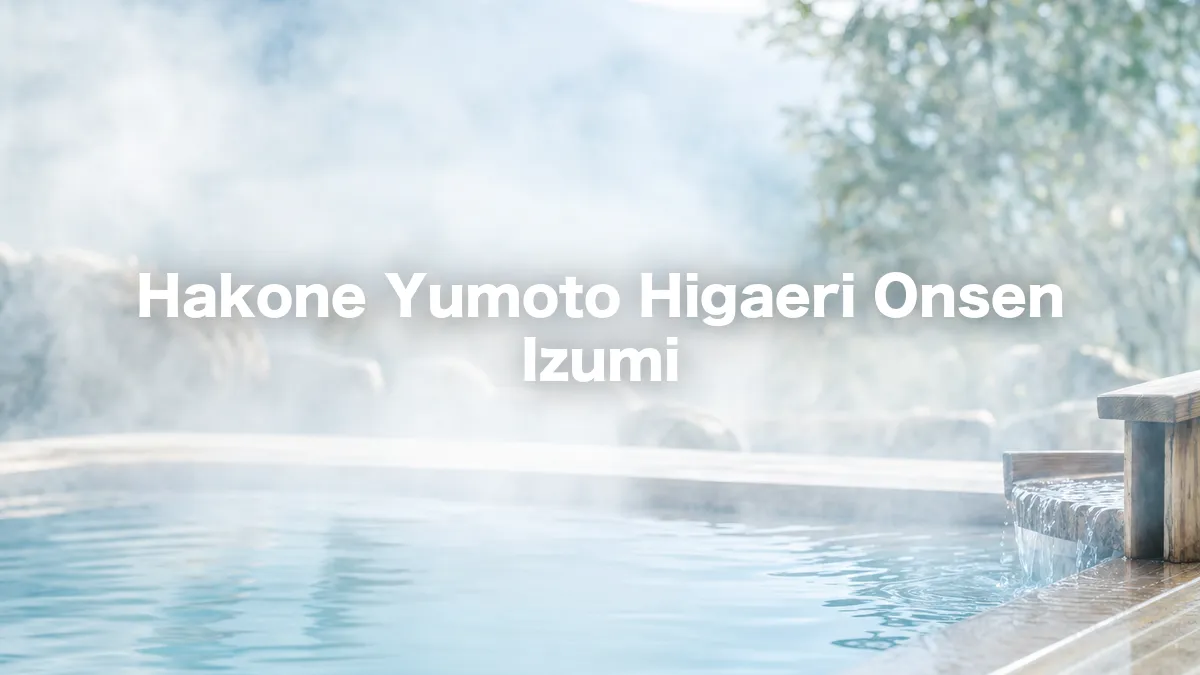
On this blog, I've been putting together a series looking into day-trip hot spring facilities one by one—the kind of place I'd stop by when I originally planned to go camping but ended up deciding, 'Let's skip that and do a hotel-cation instead.'
This time I looked into Hakone Yumoto Higaeri Onsen Izumi, located in Hakone Yumoto. When I found out it apparently uses a source called Soyu, said to be the oldest hot spring source in Hakone, I figured that even an indoor type like me could enjoy just soaking in the historical atmosphere, so I got curious and started digging in.
It seems to be a day-trip hot spring facility that uses seven different sources, including Soyu—said to be the origin of Hakone's hot springs—across two bathing rooms that switch between men's and women's use.
The Rakuten Mobile signal condition was rated C, so if you're planning to rely on your connection there, I'd recommend checking in advance.
I've put together the details below.
What Exactly Is Soyu, the Oldest Hot Spring Source in Hakone?
From what I found, the biggest feature of this facility does seem to be the hot spring source called Soyu. It's apparently an active source that still flows out from directly beneath the main hall of Yumoto Kumano Shrine, and it's classified as Yumoto Source No. 9. Just the fact that hot spring water comes up from underneath a shrine's main hall was a pretty fascinating point for me personally.
Across the whole facility, it apparently uses a total of seven sources including Soyu. The water quality is a simple alkaline hot spring, and according to official information, the pH is 9.6, the source temperature is 53.2°C, and it's adjusted to around 42.0°C for actual use. The total flow rate is said to be around 100 to 120 liters per minute, and everything—including the open-air baths and showers—is apparently filled with natural hot spring water, which gave me the impression that it could be quite satisfying even as a day-trip visit.
How the Two Bathing Rooms Switch Between Men's and Women's Use
The main bath area is apparently divided into two bathing rooms called Soun-no-yu and Gongen-no-yu, with a feature where they switch between men's and women's use on a daily basis. On Thursdays, Saturdays, Sundays, and holidays, Soun-no-yu is for men and Gongen-no-yu is for women, and on Mondays, Wednesdays, and Fridays it's apparently reversed. It sounds like a setup where, depending on the day of the week you visit, you can enjoy different tubs even at the same facility.
Soun-no-yu apparently has an indoor bath called Korai-yu that uses Soyu, an outdoor bath called Awase-yu that blends all seven sources, and an outdoor bath called Tsuzumi-no-yu that uses steam. Gongen-no-yu, on the other hand, apparently offers outdoor baths such as Bihada-yu, a weakly alkaline bath fed straight from the source, along with a hinoki cypress bath and a bubble bath. By the way, it seems that during hot spring maintenance periods, the rooms may operate on a fixed basis without switching, so if there's a specific bathing room you have in mind, it might be worth checking the official website's notices before your visit.
On the official website, I noticed that the facility's name is written slightly differently across different pages—there seem to be two versions in use, one referring to it as a day-trip hot spring and another as a natural hot spring. It looks like the latter was used as the name at some point in the past, and both apparently refer to the same facility, so there's no need to worry if either name comes up when you search for it.
Facilities and the Rest Areas That Caught My Attention
The bathing rooms apparently come equipped with shampoo, conditioning shampoo, and body soap, which is a helpful point since it means you can pack lighter. It seems there's no sauna installed, so if you're considering a visit specifically for a sauna, it's probably worth knowing that in advance.
Besides a lounge, massage chairs, and vending machines, there are also paid private rest rooms available (in sizes roughly equivalent to six-mat, eight-mat, and ten-mat rooms). If you use a private room, you can apparently arrange a boxed meal or a set meal featuring Hakone-style mountain bandit rice porridge, which might suit anyone looking to relax and take their time. The lobby apparently features walls that make use of the building's natural bedrock, the remains of a Meiji-era horizontal source tunnel, and a folding screen designated as an important cultural property of Hakone Town, so it seemed like a space where you could enjoy a bit of a historical stroll after bathing. That said, there was a period when a notice indicated the esthetic massage service was suspended, so I wasn't able to confirm its current operating status.

Just finding out that there's a hot spring source right beneath a shrine's main hall got me a little excited. The setup where the bathing room changes depending on the day of the week also felt like an interesting detail, especially for someone like me who tends to look the same place up over and over.
Rakuten Mobile Signal Conditions
I checked this facility's location (the Yumoto area of Hakone Town, Ashigarashimo District, Kanagawa Prefecture) using Rakuten Mobile's official "My Area Coverage Simulation," and the overall rating came back as a C.
Since it's rated C, if you're planning to rely on a connection inside the facility, it's probably a good idea to check in advance. Of course, actual connectivity should vary depending on the building's exact position and surrounding environment, so I'm just noting this here for reference as the result from the official tool.
I figured I just had to take the C rating at face value. It might be best to go in with the mindset of treating it as a day to focus purely on the hot spring, giving up on connectivity from the start.
Nearby Shops and Inns Worth Stopping By
The surrounding area seems to have a cluster of long-established inns and eateries. While I couldn't confirm exact distances or walking times, shops such as Chikakusaya, Hatsuhana Honten, Sabo Uchida, and Tofudokoro Hagino apparently sit right near the facility, so it seems like you wouldn't have much trouble finding a place to rest after bathing. There are also long-established inns nearby, including Yumoto Kumano Shrine as well as Yamatokan, Masutomi Ryokan, Bansuiro Fukuzumi, and Yoshiike Ryokan, so it might be nice to take a walk and soak up the atmosphere of the hot spring town.
Wrapping Up
To sum it up again, my impression of Hakone Yumoto Higaeri Onsen Izumi is that it's a day-trip hot spring facility where you can enjoy seven different sources, including Soyu—said to be the oldest source in Hakone—across two bathing rooms that switch between men's and women's use. Between the historical background and the exhibits, there seem to be ways to spend time there beyond just soaking in the tub, so it felt like a place where even an indoor type like me wouldn't easily run out of things to do.
The Rakuten Mobile signal condition came back as a C rating. If connectivity is a concern for you, it might be reassuring to check the official "My Area Coverage Simulation" before your visit to see whether it fits how you plan to use your connection there.
This article includes a referral link for Rakuten Mobile's employee referral campaign. For details, please see our Disclaimer & Advertising Notice.
Related Links
Related.Related Articles
 Hakone Area
I Looked Into Angel Grand Villa Hakone
I looked into Angel Grand Villa Hakone, a whole-building private villa overlooking Lake Ashi from the hills of the Motohakone area. Every villa apparently comes with a natural hot spring, and the facility was previously known under a different name. Rakuten Mobile's official tool didn't show any signal judgment data for this address.
2026-09-25
 Hakone Area
I Looked Into GOURA
I looked into GOURA, a tent house facility in the Gora area of Hakone. It's a pre-opening facility where both tours and overnight stays require reservations in advance. According to Rakuten Mobile's official tool, the signal condition was rated "C."
2026-09-25
 Hakone Area
I Looked Into Hakone Suishoen
I looked into Hakone Suishoen, a high-end ryokan registered as a Tangible Cultural Property that makes use of a building from the Taisho era. All 23 rooms are suite-style with open-air baths fed by natural hot spring water. According to the official tool, Rakuten Mobile signal conditions came back as a "C" rating.
2026-09-25
 Hakone Area
I Looked Into LUXE Hakone Yumoto
I looked into LUXE Hakone Yumoto, a luxury villa rental with only two buildings total, each rented out exclusively. It's a lavish property where each building apparently comes with its own hot spring bath, private pool, and even a sauna. According to the official tool, the Rakuten Mobile signal condition was rated 'C'.
2026-09-25